
Viscometer: Essential for measuring the viscosity of liquids

What is a viscometer and why is it important?
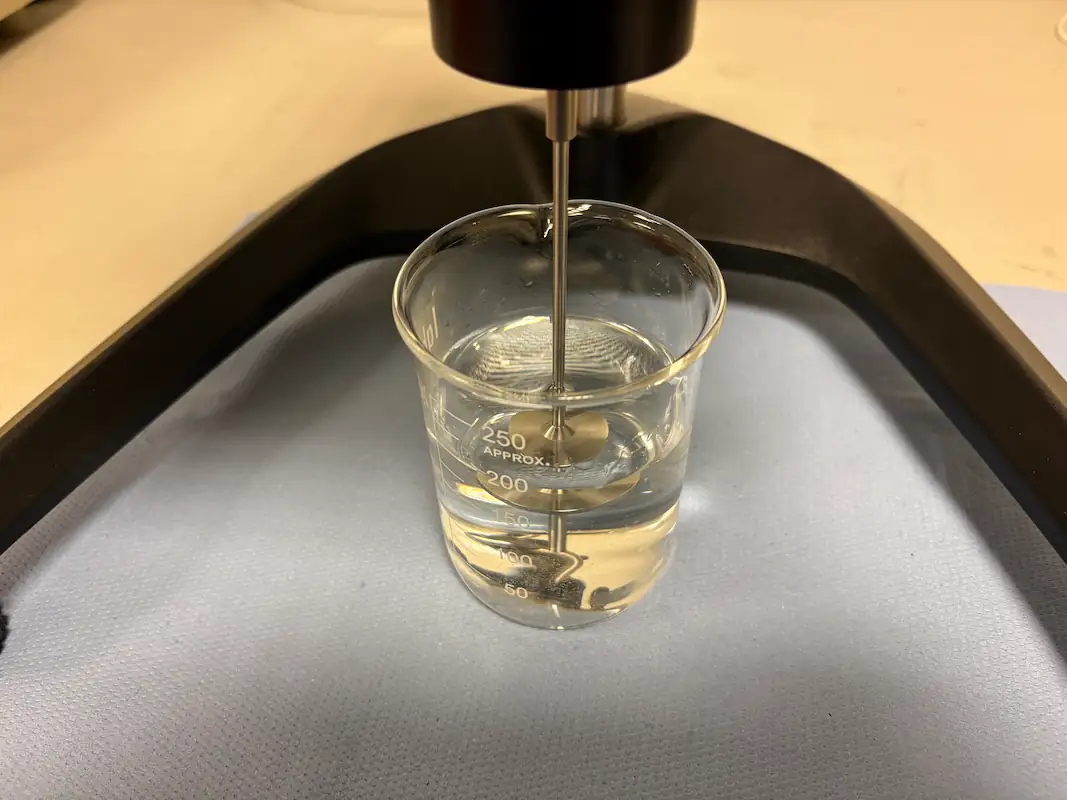
A viscometer (or viscometer) is a measuring instrument that determines the resistance of liquids and semi-fluid systems to flow. In resins and polymer systems, viscosity is a critical parameter that provides insight into:
- Reaction kinetics
- Curing rate
- Processing properties of the material
At Deon Research Centre, we use viscosity measurements to monitor chemical reactions in resin mixtures, such as polymerization and crosslinking. In this way, we can optimize process conditions, assess workability and guarantee the quality of the final composite system.

Why choose a viscosity measurement at Deon Research Centre?
At Deon Research Centre, we combine advanced measuring equipment with in-depth chemical knowledge.
Our viscosity measurements offer:
- High measurement accuracy
Detect subtle changes in fluidity and reactivity, essential in polymerization and curing processes. - Insight into curing and processing
Track viscosity through the reaction to accurately characterize workability, stability, and material properties. - Process optimization
Real-time monitoring supports the consistency, efficiency and repeatability of resin and composite production.
How does a viscometer work?
A viscometer measures the flow resistance of a liquid or semi-fluid material. Depending on the type of viscometer, this is done in different ways:
- Rotational principles: a rotating spindle or cylinder causes shear stress; the required force is converted into a viscosity value.
- Capillary or flow principles: The time it takes for a fluid to flow through a narrow tube is measured.
- Oscillating systems: vibrations or pendulum movements measure the resistance of the material to deformation.
These measurements make it possible to monitor reactions such as polymerization and crosslinking in real time, so that the processing properties and quality of the resin and composite systems can be precisely controlled.
Applications of the viscometer in industry
Viscosity measurements play a crucial role in many industrial applications, especially resins, polymers and other complex fluids. By quantifying the behavior of materials under different conditions, these measurements help with process optimization, product development and quality assurance.
Key applications include:
- Resin and polymer development
Viscosity measurements are used to monitor polymerization and curing processes, so that the workability, stability and material properties of resins and composites can be optimized. - Coatings and paint industry
By measuring the flow and smoothing behavior of coatings, layer thickness, coverage and finish can be precisely controlled and improved. - Plastics and composites
The measurements support the formulation and processing of thermoplastics and thermosets, so that mechanical properties and workability remain consistent during production. - Pharmaceutical and chemical production
For liquid formulations such as gels, suspensions, and resinous products, precision in viscosity is essential for dosing, mixing, and stability.
At Deon Research Centre, we combine advanced measurement methods with in-depth chemical knowledge, allowing us to provide our partners with reliable data and practical insights for the optimization of industrial processes and product quality.
What does this mean for your company?
By investing in a viscosity measurement at Deon Research Centre, you will achieve:
- Increased product quality: through accurate and reliable measurements.
- Efficiency in production: by ensuring that products consistently meet specifications.
- Cost savings: by minimizing production problems and ensuring product consistency.

Get in touch with us!
Are you interested in how our viscometer can improve your product quality and process control? Contact Deon Research Centre today for more information and find out how we can support your business with accurate viscosity measurements!
Contact us directly +31 (0) 6 51 06 02 62