
Tensile test: Indispensable for determining the tensile strength of your materials

What is a tensile testing machine?
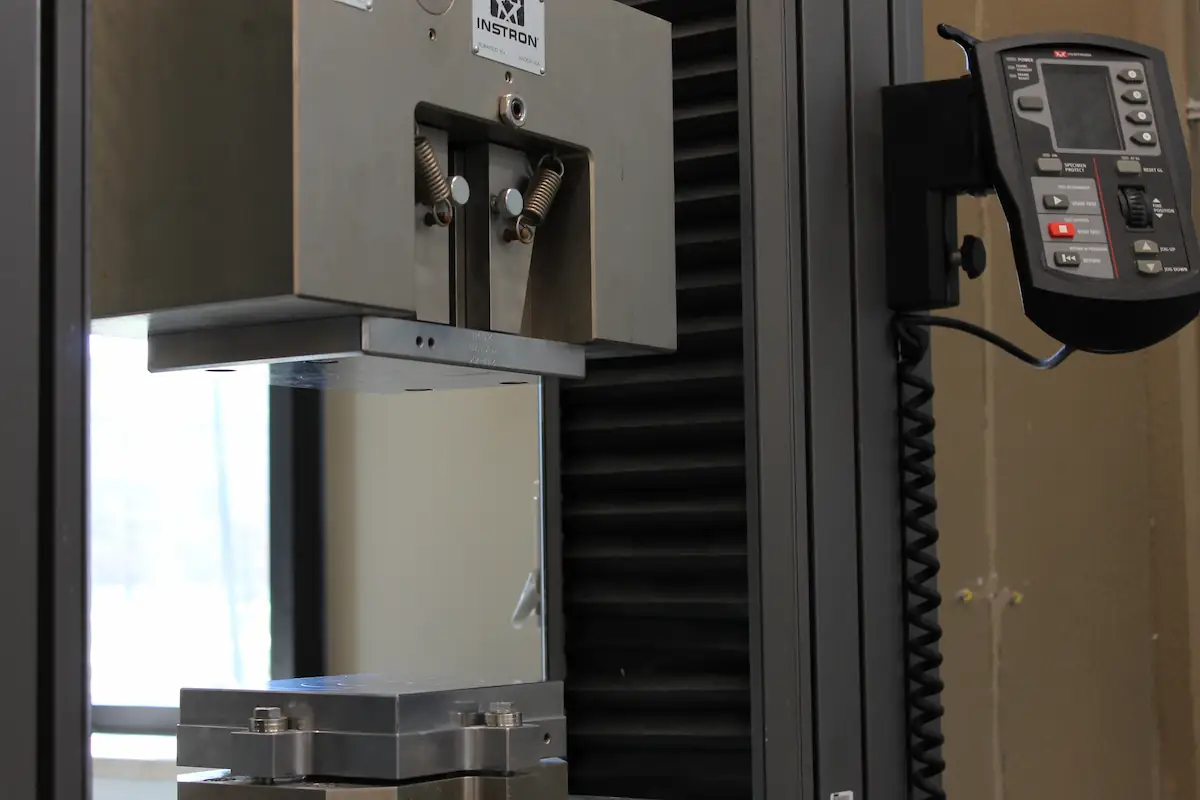
A tensile testing machine is a test device used to determine the mechanical properties of materials, such as tensile strength, elongation, modulus of elasticity and fracture behavior.
At Deon Research Centre, we perform tensile tests on metals, plastics and composites to characterize their behavior under load. This data is essential for:
- Material selection and design validation
- Quality control during production
- Research into aging and material reinforcement
Through accurate tensile measurements, we can predict how materials behave under stress, which is crucial for reliable and safe applications.

Why choose for a tensile testing machine at Deon Research Centre?
At Deon Research Centre, we combine precision technology with materials expertise to deliver reliable and reproducible results.
- High measurement accuracy
Our tensile machines provide high-resolution data, crucial for quality control and research on metals, plastics and composites. - Insight into mechanical behavior
Tensile tests provide insight into strain limits, fracture behavior and strength ratios, essential for design, validation and process optimization. - Customization and compliance with standards
Measurements can be performed according to international standards (such as ISO 527, ASTM D638 and ISO 6892) and are tailored to your specific material or process requirements.
How does a tensile testing machine work?
A tensile testing machine works according to a standardized mechanical test principle:
- A test rod or sample of the material is firmly clamped between two grippers.
- The tensile tester tears the sample apart in a controlled manner at a constant speed or force.
- Sensors continuously measure the force (N) and the extension (mm) of the material.
- Important parameters are calculated from this, such as:
- Tensile strength (Rm)
- Modulus of elasticity (E-modulus)
- Elongation at break (%)
- Yield strength (Rp0.2)
At Deon Research Centre, we use modern tensile machines with digital force and displacement sensors to generate highly accurate stress strain curves. This allows us to analyse the complete mechanical behaviour of a material.
Climate chambers for controlled test conditions
Many tensile benches can be equipped with climate chambers, which allow mechanical tests to be carried out under controlled temperature and humidity conditions. This is essential for testing materials that are exposed to various environmental conditions and can affect their performance and reliability. Deon Research Centre has this option for a comprehensive material analysis.
Applications of the tensile testing machine in industry
Tensile testing is widely used in various sectors. A few examples:
- Metals and alloys: determination of tensile strength, yield strength and tensile behavior for structural applications.
- Plastics and composites: characterization of elasticity, ductility and fracture properties.
- Automotive and aviation: validation of material properties for critical components.
- R&D and quality control: assessment of new materials, mixtures or production methods
At Deon Research Centre, tensile testing helps to better understand material behavior, ensure quality and improve product performance.

Get in touch with us!
Are you interested in how our tensile machines can contribute to improving your testing and development processes? Contact Deon Research Centre today for more information and find out how we can support your business with accurate mechanical tests!
Contact us directly +31 (0) 6 51 06 02 62